Teresa Moller’s text for her SALA lecture last week

October 11, 2009 by landscapewriting

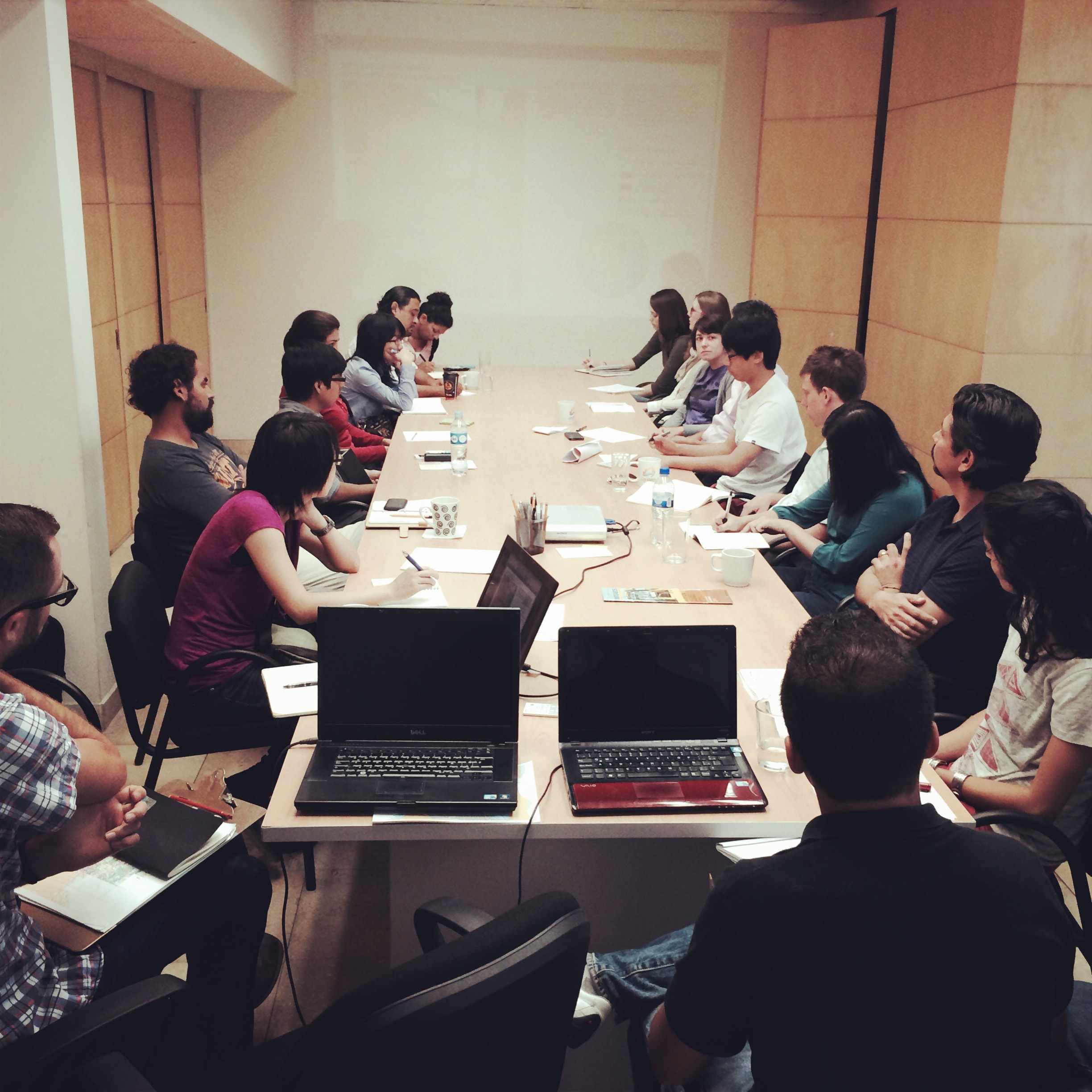
With Teresas’s permission, here’s the text she used on her last lecture at the School of Architecture and Landscape Architecture at ASU last Wednesday October 7th, 2009. Enjoy:

Good afternoon….

It has been a long, long, trip to come here,

 And I want to specially thank Arizona State University for this invitation to share the work we are doing in my studio in Chile.

You would be surprised to know that Arizona is as far from Chile …as Chile is from Arizona…

 Let me introduce you first… to some features of this extraordinary country.

 3.400 miles long north to south along the pacific coast and about 250 miles wide on average,

 That is the reason why we have a great variety of climates.

 The country is a strip of land, between the Pacific Ocean and the Andes mountains,

 Which are very high, up to 21.000 thousand feet.

 There are many active volcanoes all along these mountains. 

All this gives us the possibility of having the experience of many different forms of landscape…

 It is so much like that,

That one of our poets calls us (I mean call the Chilean culture…)

 That we were…. almost just pure geography…

 Chile is a bit like the west coast, only up side down…

 The north is the driest desert in the world, most of it 6.000 feet above sea level.

 Going south the country turns greener and greener with a central section very similar to California.

 Then the lakes district is similar to Washington State,

 and the fjords and islands like the west cost of Canada…(only much wilder) 

and then the Patagonia with low vegetation and cold climate.

 The fact that in Chile you are always seeing the mountains or the sea or both,

makes you have a very special experience about the presence of nature…

 In the life of us, Chileans, it is always there…

 We always have references and a sense of direction… because the mountain goes straight north to south…

 This can be, very helpful in life (to always   know where you are…)

 The fact that the country is bounded by the sea, the mountains and a desert

have kept the country isolated….

 giving us a sense of  being  far away from the rest of the world,

and  also of being different 

 These boundaries also explain the great variety of special plant material that is unique to this country…

 Some of these you will be seeing in my work.  

 The overwhelming presence of nature is portrayed by the high mountains, the volcanic eruptions that occur quite often, earth quakes are a common experience. I might say that this dramatic geography is the cause of a certain humility in the Chilean character

 Because of all that I have been inclined to do a work that basically pretends to value what belongs most… or is natural to the place.

I don’t want to impose my signature or my id….

 On the contrary I look very deeply in nature to find what is …what is in there, to work with…

 All this I do in different ways….

 Sometimes I found myself like a nurse…healing the wounds inflicted by man… Cumelen

 Other times we worked in recovering a piece of land in the middle of an oasis in the  Atacama desert… that was cultivated by Atacameños… centuries before the Spanish came..

 Other projects want to bring agricultural production into the landscape design work….Casablanca… where we design the plantation of olive trees, wine grapes, lavender, all for commercial purposes.

 Finally the projects on the coast line…where I try to …

 Uncover….what is in there.

Guide. people through a path…

 Allow people to get in nature,

 To have them totally immersed…

 To have the experience of nature…

 Well now we are going to review some of the projects :

 We will be started with one in the south…Cumelen….

 Josefa….

 Pite …..

 It is a discontinued walk where you have to find your own way…

 Where the construction is done only in the places where it was needed.

 If the rock wants you to walk on it you do not need to build a path…

 The fact that it is a discontinuous path makes you look for directions or signs in the landscape…

 and gives you the possibility to be in or out of the path …giving you different experiences in the landscape

 The contrast between nature and human intervention is really dramatic.

 Sometimes it is absolute clear where to walk and to go…where you are at….and sometimes you have to search for clues….

 Like  in life…

 The presence of the ocean wish is normally very rough (contrary to its name) is so overwhelming it gives you a sense of power and a temporality ….at the same time…

Landscapes of the Americas

September 14, 2009 by landscapewriting

SALA_FallLecture_2009_Page_1

With guests coming from Ecuador, Colombia, Chile, and the United States, Landscapes of the Americas, SALA Fall 2009 lectures series exposes, from a variety of backgrounds, a fertility of techniques, concepts, and contexts as part of the contemporary reality of our global interdependent world and ultimately, the discipline of landscape architecture. Techniques and concepts which involve varied mapping departures -environmental, demographics, economy, culture, beauty, science, among others- to inform and in the service of the action of designing the landscape. The series offers a collection of contextual approaches which value site specificity while engaging and connecting abroad through blogging, traditional publication, competition, and activism. The series will enlighten the scope and reach of landscape architecture as a discipline which not only articulates with a multiplicity of professions, but also with a heterogeneous, contrasting, and stimulating growth and influence in different parts of our continent. Our guests are Felipe Correa (Harvard, Ecuador), David Tulloch (USA), Carol Franklin / Andropogon (USA), Teresa Moller (Chile), Luis Callejas / Paisajes Emergentes (Colombia), and Tom Oslund (USA).


Paisajes de las Américas:


Con invitados de Ecuador, Colombia, Chile, y los Estados Unidos, Paisajes de las Américas, el ciclo de conferencias de la Escuela de Arquitectura y Arquitectura de Paisaje de Arizona State University en Tempe, Arizona, expone una variedad de orígenes, una fertilidad de técnicas, conceptos, y contextos como parte de la realidad contemporánea de nuestro globalmente interdependiente planeta, y finalmente, la disciplina de la arquitectura de paisaje. Técnicas y conceptos que involucran diversos puntos de partida y mapeo: ambiental, demográfico, económico, cultural, estético, científico, entre otros- para informar y en el servicio del accionar del diseño del paisaje. El ciclo ofrece una colección de aproximaciones contextuales que valoran lo específico del sitio al tiempo que emplean y comunican abiertamente a través del blogging, publicación tradicional, competencias, y activismo. El ciclo iluminará el objetivo y alcance de la arquitectura de paisaje como una disciplina que no sólo articula una multiplicidad de profesiones, sino que también posee un heterogéneo, contrastante pero estimulante y creciente influencia y desarrollo en distintas partes de nuestro continente. Nuestros invitados son Felipe Correa (Harvard, Ecuador), David Tulloch (EEUU), Carol Franklin / Andropogon (EEUU), Teresa Moller (Chile), Luis Callejas / Paisajes Emergentes (Colombia), y Tom Oslund (EEUU).

SALA_FallLecture_2009_Page_2

PATTERNS OF INHABITATION: A STUDIO ON INTENSIFYING THE SPRAWLING DESERT METROPOLIS

March 30, 2009 by landscapewriting

(Poster description presented at the ACSA annual conference “The Value of Design”, held in Portland, OR, March 26-28, 2009)


This is the work of a multidisciplinary studio (architecture + urban design + landscape architecture). An exploration of a critical method/approach in response to the contemporary challenges posed by the suburban paradigm of the sprawling desert metropolis. The studio is a landing and grounding effort striving to configure a research index and basic map of the site-specific capabilities of the city to be re-founded within its repetitiveness once the new urban challenges of the world manifest after land/economic availability wears down and the energetic renewal arises. The main operational idea of the studio was to identify, map, analyze, interpret and deploy design strategies “informed on the informal” matted over the formal generic landscape.


How can we propel the soon to be certain post-sprawl metropolis and rethink the city through architectures and urbanisms that integrate and activate the ongoing adaptive processes growing to become a mainstream physical culture?


We worked in (sub)urban areas that have inhabited and collected cultural practices for a long time (we determined a timeline starting after World War II). We established fertile grounds for future development in often forgotten or socially disenfranchised environments revealed by mapping spatial potential for new densities. We characterized and isolated the facts of human inhabitation – adaptation to improve and intensify the built realm looking into the future energy transformation and the forthcoming demographic re-composition of the American Dream. We processed our semester through the experimentation of alternative or informal development patterns in sections of the city’s fabric where time/inhabitation have done the often invisible/overlooked work of place making; but at the same time still remain generic and unattractive to most of the population. We embraced sites with integral urban conditions that could be invigorated both through the means of dwelling intensification -the private domain- and also with site specific actions of public space/urban structure where action in the collective realm became urgent after the mapping analysis and community interpretation.


Three were chosen: Downtown Phoenix as a place under a de-habitation process but enjoying a history, a culture and meaning. The City of Guadalupe as a cultural enclave in dire need of socio-economic stimuli. And Maryvale as one of the original expansive suburban mantles where the development surge is long gone substituted now by the overlaying of densification derived from immigration patterns adding a new cultural practice in the re-composition of the social basic units: multigenerational families, groups of males living together as a result of primary migration processes, and the grouping of people of similar origins.


The studio thinks of the inhabitation of the city as a system of thresholds: a construct of spatial grading articulated through patterns, both physical –revealed by mapping techniques- and abstract –negotiating socio-economical boundaries within the city-, both formal and informal. Ultimately, managing to distill this outline of the human essence of Phoenix’s inhabitation will become a larger studio based design research concurrent with the change of the times. studio-patterns-of-inhabitation

Mexican Territories

December 6, 2008 by landscapewriting

mexican-territories

The main objective of Mexican Territories is the exploration and understanding of Mexican inhabitation of territories through history departing from notable case studies of urbanism and architecture, focusing in the relationship and evolution between culture -society, economy, and politics- and the built environment. From hierarchical emblematic power structures to self-developed, self-produced, informal, emergent patterns. And from Pre-European inhabitation, to the Spanish Colony, the Independence, the Revolution, Modernity, and Contemporary Times, ending with an emphasis on the neighborhood between Mexico and the US and its effect on the physical landscape.

(SALA ASU, SPring 2009, Special Topics, LPH494)

The Edge in the Center: Public Places and Informal Landscapes in Chihuahua

October 15, 2008 by landscapewriting

Article published in LABREPORT 2 by the Phoenix Urban Research Laboratory and the College of Design of Arizona State University. You can download it here: http://design.asu.edu/purl/labreport.shtml

Contemporary Inhabitation of the Chihuahuan Desert: A Binational Cultural and Natural Landscape.

August 18, 2007 by landscapewriting

Paper presented at the CELA 2007 conference held in Penn State University, August 15-19, 2007.

By Gabriel Diaz-Montemayor 

The border region shared by Mexico and the United States establishes more than just a political line dividing the continent and its ecosystems. All along this area an irregular stripe contains a culture embedded in a nonlinear system of transversal cultures, regions, and ecosystems, shaped by the natural environment, politics, economy, and an isolation condition derived from distance of the hierarchical centers of both countries. Here, the border recognizes itself and no other, artificially materialized as a fence, or naturally existing in a river it often becomes invisible in the natural flows going back and forth, in drainage systems, in heavy massifs that overwhelm the fragility of the built symbolic division elements, and in human movements that replicate the landscape behaviour in the interactions along this region and in the bi-national city of Ciudad Juarez, Chihuahua, and El Paso, Texas[1] 

The contemporary cultural alienation of the urbanization patterns of Mexico are present from the scale of the single unit dwelling to the scale of the city. As socio-economical movements are forced northward into the United States, this bi-national city has become a depositary of cultural and economical contrasts. The second largest metropolitan area between both countries displays a contiguous urban relationship evenly distributed in their contact areas along the border. The city between the exhausted attractive paradigm of suburbia and the prevailing alienated pattern of the sought dream obstructed by the incompatible humanly natural informality of the poor enhanced with the formal detachment of the privileged. Between the well known formality of El Paso suburban development and its employment of arid materials in their attempts to landscape the prevalent infrastructural public networks and the informality of Ciudad Juarez and its alternative means for colonizing inhabitation of disenfranchised terrains, resides a field of opportunity to learn and act with the complex site specificity of this still young community formed by migration abroad. The melting pot for emergent inhabitation as a temporary unstably dynamic realm is found in its purest form in the informal outskirts of Ciudad Juarez. Where queuing multi-cultural population consciously unadvertedly manages to inhabit the landscape and whose constant attempt, trial, and error with the scarcest resources is almost officially disregarded as a possible analogy to inform the recognized realms of the formal bi-national variations for life in a harsh desert. 

The western end of Texas, the southeastern end of New Mexico, and central northern Chihuahua, receive the bi-national metropolis of more than two million formed by Ciudad Juárez (CJZ) (1,313,000 inhabitants[2]) in the Mexican state of Chihuahua, and El Paso (ELP) (598,590 inhabitants[3]) in the American state of Texas –and its conurbations in the western side of the metropolis on the state of New Mexico-, reacts to the line by an average of 60,000 thousand daily legal crossings through the bridges over the river, and through land in the only accessible to the metropolis crossing point between the New Mexico – Chihuahua border. The average urban gross densities of Mexican cities in the area is of 9,000 inhabitants per square mile[4]; while the average density of southern cities, more compact and in wetter climates, is as double as that (70 inhabitants/hectare). Meanwhile, US cities in the area –as ELP- have an average density of 3,500 inhabitants per square mile (13 inhabitants/hectare). The metropolis is located in the center of most disperse inhabitation of the North American continent. At the detail scale, however, an urban density map of Ciudad Juarez and El Paso would expose the 2.5 times denser south against a sparse north. 

The territorial re-colonization of the southern United States by population of a Hispanic origin is an obvious fact, but it does not depend only on a South – North directed flow. The other, from north to south occurs in the American cultural colonization of the urbanization patterns of the American Dream that have weakened and in some areas vanished the inhabitative traditions of Mexico. In today’s built environment of this south, urban form is shaped following versions of suburbanization patterns, in a permanent struggle for adaptation derived of economical differences that constrict infrastructures and properties.  Today, to the distracted visitor, a dreamed landscape of grassy meadows and tall and green trees, forced into Ciudad Juarez high income areas might be ordinary, an urban must. Just another example of suburbia developments that turn to be forced into narrower and smaller lots, in a futile –but locally effective- attempt to reenact the American dream. A landscape of European roofs for snow and water to capture a rainfall of less than 10 inches a year. Residences forcing steps into flat topographies with the outcome of a constant promotion of investment on introduced, non native, urban behaviour, and inhabitative practices. 

As the City sprawls into the dry landscape into the bent plane upward of the nearby mountains, so does the lack of educational and economical alternatives for their inhabitants. The delicate flows of the terrain into the Rio Grande divide the city in two halves, the west for informal self developed and built low income developments, and the east for formal high and low income subdivisions. In between them in the central area, the traditional downtown and surrounding traditional neighborhoods slowly erode as their inhabitants grow old, migrate, or find their place in the realm of intuitive unassisted vibrant human reverberation of slums. However, fueled by the fixed Mexican obsession of progress, this is the metropolis located within the nearby experience of the American dream is real to many due to geographical proximity and the gradual concentration of a population not born or belonging to pertaining generations on site. The American urban culture is strongly embedded in this area that is the only one with some capability to apply the dream, being the north the richest half of Mexico. 

The examination of the informal city in the Chihuahuan realm, and therefore by opposition the formal city, is an unfulfilled task for most of third world -or countries under development-  cities on earth. Here, the common concept of urban planning relates to a paradigm image of perfectly ordered zoning maps, circulatory structures, defining overall a general vision of the city, development direction, deliberate orientation and its forecasts. In a way, planning is a device for euphemistic detachment –or quimeric- from reality. As a mainly governmental responsibility, the solid colors and uniform surfaces successfully hide a much more complex truth. This is one of the numerous places in Mexican contemporary society where the contrast between the refined urban ordinances of urbanists and the third world realities collide making the mapped formal city unrecognizable on site. Today, most of the northern Mexico cities rely on individual car transportation systems that do not relate to unprofitable areas that belong to the extense informal realm, often making the contrast invisible to the privileged classes owning a car. Even though cheap junk cars imported –either legally of illegally- from the US are affordable to many, this similarity finds a way to be obscured by the cultural class detachment between the rich and the poor, the formal and the informal in a country positioned 103 out of 126 in an inequality scale recently developed by the UN. Poor circulate in their realm, and traditional downtown areas of Ciudad Juarez and El Paso. The rich circulate in the formal realm and commute to malls in the outskirts and conurbations of El Paso, closing the circle of economic interdependence. 

This informality is understood as a concept that relates to unregulated urban facts while on practice relates directly to urban density, fostering the highest indicators along with subsidized formal government housing. Outside the boundary of the planned –and taxed- development the informal just “happens”. Is manifested in the daily behavior and action of human inhabitation of their realms. The informal happens either in the private realm or in the public one. In the private realm, appears in the shape of gardens, color, additions or personalizations, incredibly inventive delimitation practices, and creative platform structural earthworks that on one hand offer a transparency suitable for solidarity and interaction, but on the other maintain a grave degree of physical vulnerability. The informal is part of culture and social expression affordable to the citizenship as it gives character to the city, found either in the beggar of the streets, in street clowns, in the fire-eater of the nocturnal red light, in street flea markets, in the walking candy man, and in diagonal paths marked by movement in the malleable terrains, vacant lots and natural vestiges.  

The predominant informal realm relates to a kind of movement. To dynamics in the sense that it is not fixed, it is not stable. If compared, the formal realm stands statically. And, if conscious, as far as the city is concerned, the solemnity of the formal (approach or idea) is un-attractive, obsolete, and insubstantial, paling at the side of the sustaining pumping vitality of the human part of the city. In contrast with high income areas where the public realm is defined –by sidewalks and pavement- and completed –by the required percentage of parks that subdivisions have to provide- the low income areas historically developed in an informal pattern that followed in accidented and expressive surfaces and landforms the abstractly flat grids stretching from the traditional city centers to a topographic adaptation as a light and ductile mantle falling into the earth, without built definition of the public and the private –no built pavement or sidewalks- and without provision of public space since no ordinances are followed besides the logic extension of the known order of the open and connected city. Slums concentrate denser populations that form neighborhoods and communities closely related to their site by inhabitation.  The evolutionary ownership in practice can be even traced back by the fragmentation of original large lots into smaller sections for sons and daughters, and grandsons, becoming a revolving informal subdivision pattern that escapes cadrastral registration. These larger lots that developed without urban services of any kind now shelter generational inhabitation that gets expressed in the visible –the static- elements of the physical realm. 

In high income developments, the dream landscape is made by gated communities rejecting the urban, avoiding undesirable city life. Fractioning even more the natural landscapes of the urban peripheries with their surrounding walls. Houses at the center of the lot with perimetral green lawns in the US are substituted in Mexico by a packed two story house into a narrower width, with a front yard average restriction of 1/5 of the lot lenght, no lateral lawns, a 4 feet corridor in one side, and at the back the repeated obligation of the backyard which remains disarticulated from the unit wasting up to 30% of the lot’s area in favor of a proto-typical ideal devised to follow up the centralized building in the lot. The formal low income developments –including those developed by governmental assistential and or subsidized housing- respond analogically to the same pattern in their smaller scale of customary lots of 23 by 59 feet. This approach to dwelling –and therefore to the city- speaks about the degenerative processes of outdoor life in such a perception of the sought urban pattern. Where formerly the courtyard or “patio” acted as datum for organization and use of the dwelling, regulating high temperature with natural ventilation working inside out; the alienated foreign paradigm has settled and affected urban form.  

The formal nevertheless has failed from articulating the city, as the regulated subdivisions and developments pertaining to urban ordinances have managed to cluster a “system of detachment”, a series of unarticulated grids or geometries –with gated developments becoming the favorite pattern- that accomplish zoning percentages and requirements but forget any other urban aspiration besides, sometimes, filing and filling a technical report indicating a verifiable automobile capacity in the connection points with the rest of the city. All new developments have a requisite for open public space. But laws just require a percentage for these donation areas, not requiring these elements to be related to a hierarchical composition as part of an urban structure defined by parks and plazas. The relationship of dwellings to these spaces is on many occasions almost a coincidence of development. Designers worry about giving the highest number of lots, sacrificing the rationality and potential of donation spaces. Many of these neighborhood donation areas relate to property division walls or to sloped terrains, while many of the dwellings don’t enjoy an even proximity with their parks. 

The challenge of ordering the planning riddle existing in physical contrasts not only inside Ciudad Juarez but between both cities is slowly developing. However an effort has to be done to address the extensive informal slums that contain a social and cultural structure that if registered correctly would be of great value to orientate government or associated investment and interest with a great potential on teaching alternative inhabitative patterns in the public and private realms. Placing the money and action where it is really needed for a neighborhood –strengthening communities arisen by solidarity and interaction-  and not where it is needed for another extensive section of the city, normally of the commonly attended higher income areas. As the bi-national city sprawls in the desert and in an economy under development, it manages to survive at a high social cost derived from obstinate blindness toward adaptive conditions found in the multicultural disenfranchised realms. In a society where more than half of the population is below the poverty line, and vital resources are shrinking, the need to focus on new hierarchical urban concepts is mandatory, especially those regarding public space and the alternatives for improvement within low budgets and opposite urban developmental patterns. In time, the inhabitants of the desert will have to learn to look inwardly and recognize themselves as part of the integral human thrive to subsist in the endangered and fragile system that supports them into a paradigm shift in the domestic and public realm. 

Addressing, attending and learning from the citizen physical gestures of the integral urban realm –formal and informal- would considerably enrich the standarized common structures already considered in local planning. With a paradigm shift in the general vision of the city some of the missing layers could make, through analysis, emerge the alternative orders beneath the built that become analogical to the opposite formal urban realm informing all of the systems and structures enforcing the human factor in the bi-nationally economically ridden city.  A chronological and systematical observation, registration, and analysis of dwelling growth and inhabitation practices would be fundamental for the design of that social stratum housing, especially those in the fringe of the city or in its internal boundaries around “no man’s land” areas of derelict abandoned industrial areas or the natural accidents that remain unresolved inside the city. This could also inform the inhabitation of the last boundary of the city, the limit between the natural and the artificial or urban, and possibly even the inhabitation of the ultimate boundary in the shared fronteir.  

Attention in these forgotten areas will discover construction, gardening, color, delimitating (fencing), all of them ahead and outside ordinance practices. It could also reveal the unique social group structure with high political potential as both cities are a bi-national melting pot. Shift the formal impersonal concept of urban planning into a social activity, take the analysis and action in situ. Expose and extend proposals and analytical conclusions to the and from the unpaved street level. Make color in planning –or urban understanding- and materiality of public works not only a definition of use but of intensity and inventiveness of human interaction.  For the US and México, sharing and promoting bi-national technological advance as a tool to improve the built environment that is equally strategic and tactic in both sides of the border and a gradual conversion to regionalization of the mutual agenda could do better than the international debates on the difficult relationships between every country, especially in border communities like Ciudad Juárez – El Paso. Getting decision taking to ground level, to neighbor level, has the potential to tighten the permanent transversal flux, changing the obsessive attention granted to the machinistic realm into the human realm, and celebrate the urban, and act on life.


[1] Both originally belonging to the same settlement under the name of “Paso del Norte”. Meaning literally “North Pass”: the ideal river crossing point in this stretch of the Chihuahuan desert landscape of the “Camino Real” (Royal Road) built by the Spanish.[2] INEGI of Mexico (National Institute for Stadistics, Geography, and Informatics).

[3] US Census Bureau.

[4] In México the normal way to describe density is inhabitants per hectare, this would be 35 inhabitants per hectare.

The City: In Praise of Limits.

June 25, 2007 by landscapewriting

The city is a thing, a construct as it has a boundary, a texture, a color, form and shape, volume and content, idea and concept. Even though it is a daily fact for more than half of the world’s population, it is one of the most difficult things to grasp and understand today[1]. On opposition, the analysis of ancient cities is rather eased by distance and time and taken as the prime examples that often fall short to explain the vague contemporary urban realm. The city is a riddle too difficult to solve. A contortionist mass expressive only in its lithospheric but suggestive surface over a revolted and hellish core. A broken puzzle in which we don’t know if the pieces are complete, or even if the frame and size is static or sprawling into the edges of the supporting table that’s our society as whole: politically, economically, culturally, and ecologically. Or we could say much more pragmatically as Alex Marshall, the city is its government (politics), transportation (systems), and economics[2]; the reasons to be of the city, “The Sex of the City”. The city owns the main physical realm in which the intangible presides and evolves in liberty towards the extremes of a today equally undefined territory for good and bad, for soul and matter.Control.

Cities are about control. Control is about limits that can become physical or physiological. There are some limits that materialize as physical boundaries and others that are in fact a variant frontier but is thought so as something else obscured by function or meaning. Urbanists –or suburbanists- seem today to be a variant of the Blade Runner possessing the sense to designate human from not human, seeing clarity in disorder, forecasting catastrophe or welfare. Our environments are as blurred as the margin of error on retiring or executing a person[3]. In the end, the machines, become an “inhabited boundary” and actually live on it developing emotions, even love. Can our contemporary cities live to the point of becoming something else more that our living quarters? Isn’t already our notion of the city, or more precisely, the lack of the notion of city a symptom speaking of a new world much farther away than the new urbanism, the old urbanism, and the ubiquitous suburbanism? The city as an unanimated thing has acquired breath and pulse almost like having being dormant for centuries awaken by the sirens of nature’s exhaustion. The limit and control that the city itself represents and lately acutely demands is a new state derived from an unconscious attempt of humankind into a “more human than human city”.

The contemporary need for euphemistical limits -and therefore of control- reveals an adolescent society. In an ever evolving polarizing culture, limits and control are in fact much more enjoyable than before, just like a reckless teenager enjoys constant risks. The celebration of living in the edge is the symbol of the times. The enclosure of the individual’s world is frozen in the city as enabled by a behaviour analogical to foreplay in the edge of a precipice. However, unfortunately, as society became individualized, life in the fringes conversed into a simply private activity where the presence of the public/government gets easily ignored and equally undesired. In some way, the urban statement of Alex Marshall explaining the government as the operative system and the private as the software working atop it is analogical to the superb relationship of the individual itself to his peers, “everything gravitates around me”, not to say to society, something that automatically should include the public, therefore the government although this seems contradictory with the described independentist will of the individual. Contemporary times are messy but analogical, the city is the prototypical average individual. As an individual each one is unique and has the potential to mature. The adulthood of the city meaning a new relationship with its control devices –limits- is something yet to come… or to return.

Growth Boundary… the most effective tool for urbanism in the last half-century…”[4].

The notion of control, and therefore limit, can be attached to the presence of any form or expression of government action. Either in the strategic vision of the city by zoning, ordering, or administering, and in the tactical reality of transportation systems and the whole series and networks created by its deformed composition of lines of every width and function: streets, avenues, alleys, sidewalks, electrical lines, sewage lines, gas lines, telephone lines, property lines. The city is composed of limits for every kind of reality, from the physical to the subjective, from the collective to the individual. However, one real limit, the boundary of the city is constantly neglected.

The variety of definition elements is such that even although not seen -on average- as limit(s) in the end they become part of the system of physical limits that creates the notion of a labyrinth like composition of the built. The establishment of limits respond to a matrix of complex information that easily traduces into an illegible construct, since most of the boundaries societies embrace are simple physical mono-functional facts. The urban realm as a conglomerate of frontiers often contradicts and detonates the perception of a limited everything in the city. To the point that some of the very elements that should be integrationist become the opposite in parks accused of favoring certain socio-economical levels, streets favoring specific areas and forgetting others, railways that put you on “the wrong side of the tracks”, etc.

City states of medieval times employed the surrounding walls that materialized the governmental and political system of the times for defensive purposes. In those days, the city, the gregarious concentration of individuals protected themselves from the outside country side that fostered the unknown in the open promenade of fields for approaching armies. Walls hid inside what today we remember in nostalgic praise: an intense urban life. Today, the struggle for coherence in a world suffocated by over expansion but relying on it as a free market economy policy has created an opposite effect in the sense of over-control. The walls of the past gasified and were inhaled by society. It is as today we have to defend ourselves from the enemy within. The individual is forced to establish mental boundaries for enclosure and containment of being against the globalized sense favoring affordable, possible, reachable consumption. Or, more accurately, having the frontier dream with the potential to tranquilize our main media of future apocalypse derived from the –so exposed- swollen wound that is today our urban realm.

The limit, the wall, contained space for transportation of military goods along its width and also enabled interconnection between the dilatations in the shape of defensive towers allowing for wider purposes or living quarters. These traditional “public limits” have been substituted in modern society by transportation systems making use of the liberated space, or, as a reminder of past societies to sweeten life and add to economic activities, as is the case of numerous European cities. The walled limit is today often parodied and offended. The fixity and simplicity of the partition and of the boundary is constantly overrun by economies or simply for the fun of doing so. In the case of urban development, the limit is an utopian concept. Especially in economies that base their industries and economy to the urbanization of “empty” land, to the point that the perception of the surrounding natural terrain of the cities is “vacant” land.

corona-limit-2.jpg

The Great Wall of China is attacked by an army of Mexican “Charros” in a Corona beer commercial advertisement[5].

The New Limit.

Today’s urban conditions reside ahead of the affordable technology that in a near or distant future would consolidate the new living endeavour of society. In reality, as a social construct, the city shouldn’t be thought as something relying on technology[6]. With the affordable urban tools of today, there are alternative ways for inhabitation waiting to be explored, and one of them is the notion of limit –including its content of control-. The inhabitation of an inland boundary detached from the abstract sense of the invisible lines of maps and drawings has still to exorcise the negative notion of imposed control that brinks and margins mean. The renewed experience of the limit, of the fringe, has the potential to redefine the individuality of surrounding and neighboring entities that today represent the main contradictory dualities of our mainstream thought: nature and urban, virgin and marred, empty and full, ground and figure, social and elitist.

“The edge of the city is a philosophical region, where city and natural landscape overlap, existing without choice or expectation”[7].

A new notion of limit, and therefore control, in the gregarious realms of urban environment could provide new ways to understand, or to finally taxonomize the city itself. If one limit is enhanced, promoted, and grown as the ultimate “b-ordering” fact, the limits within will loosen, and blur into more uniformly varied and enriched towns. The return to the wall, or to the figured wall is imminent as the concept of sudden collapse is more appropriate than the expected normal wear and tear we relatively enjoyed in the past centuries.

Widening the notion of a limit is physically something we are accustomed to –streets- but not in a sense in which the element can become and provide within it, on it, an interstitial potential to experiment the space by activity or by meaning. As our world is divided in the private and public realm, all through history of civilization the fixed notion of the limit belongs to a governmental therefore public responsibility. The ownership of these limits is then, public. However, the actual non-existence of the “Edge of the City” is a fact in most of the urban areas in our world. Either as a physical tangible thing or a geographical abstract line dividing incorporated land from the rural and natural environments the limit finds few references and remains still under powered to trigger a worldwide initiative for the application of such a strategic and complex tool.

Informing the New Limit(s).

The new limit could inform the definition not only from the society they would hold, but also in the natural physical space they would spare. In the untouched realm, the limits between the natural ecosystems are difficult to define. Naturally, the definitions of ecosystems behave as the tide of the sea. Coming in and out, these are composed of a large range and layers of information that have an inconsistent non-linear hierarchy. Sometimes a factor is more important than the other. Either for elevation, appearance of some vegetation species designed as markers, exposure to winds and solar rays. The limit is then, in nature, a widened space diluting the notion of boundary into another type of space, an alternative kind of interstitial almost seasonal space. The limit is not fixed.

Steven Holl proposed in his fringe projects physical boundaries composed of a rhythm of buildings containing multiple diverse programs in opposition to the average mono-functional building found today in the peripheries. The perception of the limit as a place to stay, much more than a dividing contrast but a position by itself from which to experience in between both poles. The dynamic of this limit is then a variety of activities. The unfixed character is gregariously human and formally its materialized in writhing volumes.

The future utopian edge of the city of Phoenix as envisioned by Steven Holl[8].

Conversely, Portland’s Urban Growth Boundary is one of the few notable and –most importantly- operative examples available today. It is an example of a territorial boundary and not a physical like Holl’s proposal. However, the UGB contains a multiple physical character as its conformed by stretches of rivers, streets, and invisible lines. The result of such a composition is an amorphic shape appearing to be a still frame of the “contortionist city”. Limits have changed from the absurd continuity of the Great Wall of China to an heterogeneous collage. Conceptually, the overlaying of the basic fixed compositions of the past, the programmatic diversity of the fringe, and the complex geometry of the city results in a fringe territory where opportunity develops as a cleared field.

These examples of dilated/expanded/diverse/composed limits of different nature shall include the practice of sharing and sparing: a difficult task –and possibly contradictory- for our human nature and our approach the strict concept of control or limit. But, as a whole, these can reveal a new notion of boundary and a hopeful new notion of order.

New boundaries will establish new relationships. If processed and explored, a newborn limit typology could define new areas and have the potential to make places. Places that hadn’t existed before. The new limit will challenge the remaining structural conventions: shifting the public –governmental- notion of the limit to a private or shared status and responsibility: redefining ownership. Serving the whole, the urban and the natural, by adapting the fixity of the mono-functional built realm and the diverse, life-cycle, seasonal ecologies of nature, society, and cities. Embracing the limit as the analogical field where opposites touch. An interstitial space that as the word itself stands in action. Enhancing the limit as a layered order. Converting the limit into a dynamic, multipurpose, space where leisure and function flower as the maintained garden of citizenship. The Sex of the City gestates a new control as the soul of city.

[1] Except for the media that lately has shifted to voyeurism when in between the pages of a fashion magazine you are able to find a photographic article of the lively slums of a country far away.
[2] Marshall, Alex. “How Cities Work: Suburbs, Sprawl, and The Roads not Taken”. University of Texas Press. Austin, TX. 2000.
[3] Citing the store behind “Blade Runner” written by Philip K. Dick and immortalized in the cult film by Ridley Scott.
[4] Marshall, Alex. Ibidem.
[5] Still frame taken from Youtube.
[6] Specially if the “great” cities of the XXI Century are located in the “under developed” world.
[7] Holl, Steven. “Edge of the City”. Pamphlet Architecture 13. Princetown Architectural Press. New York. 1991.
[8] Image taken from: Holl, Steven. “Edge of the City”. Pamphlet Architecture 13. Princetown Architectural Press. New York. 1991.

Going to the City: The Contradictory Sanctuary.

June 19, 2007 by landscapewriting

An essay inspired by “Maria Full of Grace” (2004) by Joshua Marston, “Cidade de Deus” (2002) by Fernando Meirelles, and “He ni zai yi qi” (Together) (2002) by Kaige Chen.

“Allá todo es demasiado perfecto” (Over there everything is too perfect).
Lucy describing New York City to Mary in “Mary Full of Grace”.

Sin City, Dark City, Gothic City, versus the bucolic, pastoral, rustic shire and the orderly fixity and timelessness of the rural: a tireless place to explore humanness. In opposition, the perfection of the urban, its straight lines its merciless reflection, its even surfaces are far too suspicious. The improvisation and coarse texture supporting contrast and light of the rural should be embraced or at the least remembered. The relationship between the individual/collective is indissoluble from the environments that endorse character, culture, and moral values. And these are, in their gregarious nature, urban. But the basic abilities to socialize are in their personal nature, rural. As solidarity and virtue come from the rural, a concept each time more confused and blurred with: Family.

The pagan city and the sanctified rural realms are represented in the moral values that migrant populations from farmland landscapes carry with themselves into the hopelessness of the urban. A moral taken to be lost or disrespected either by choice or simply forced by the new environment. In the case of “Mary Full of Grace” (María llena eres de gracia) the employment of a sentence extracted from a widespread and recognized catholic oration is symbolically –and blasphemously for its religious doctrine- used in a series of evocative passages during the adventure taken by Mary’s choice to deliver a processed illegal product to another country and another corrupt urban realm. Pregnant Mary is taken to the city in the back of a motorcycle, just as if riding on top of a donkey to Bethlehem, but accompanied by an ephemeral Joseph, an urban scoundrel dedicated to collect and pervert souls from the virginal fields. Mary abandons a tight feminine family nucleus: the mother, the grandmother, and single mother sister. There is no reference of men in the family that should explain the generations inhabiting the compact dwelling. Where are these men? Mary swallows cocaine pellets as if having the ritual communion of Jesus Christ body. A priest like hand handles her one of the dozens of white capsules. Mary is naïve as she should be. After all she hasn’t seen much in her small town lost in the mountainous surroundings of Bogotá. However, Mary finds a just man, a solidary woman, and a cultural enclave where she can be, maintain culture, pay for a gynecologist in her own language, and thrive.

In the recently inaugurated City of God the boundlessness of the rural realm is present in the not yet divided still shared backyards that become the hide and kill field for the juvenile offenders corrupted by segregation, by separation from the vitality of the main economic area and activity of the city. The City of God is neglected from its origin detached and behind the mountains. Children take refuge in the nearby swamps to bathe and discuss the future; thieves find cover in the shady tree canopy. The glow of the City of God is not visible from the central city, no one cares. The opposite is the norm: the gathering of thousands of lights reveal at night a distant realm. The passage from the city to the contradictorily ordered but slummy ghetto is flavored by darkness. There can’t be anything sacred from the City of God; except for opportunities that can emerge from the most unlikely coincidences. Traditional family structures are substituted by friendship and complicity in the shape of gangs of all ages. The know-how of the family resides in the basic tie of one to another. The two gang leaders are a couple as the young photographer with his unknown –and useless except for its company for the purposes of the film- following friend.

The feel of the peasant village with an anomalous violin virtuoso is found in the city in a contrasted courtyard where debate can still be fostered by such primitive combustibles as domestic coal. A visible patio from an apartment building menacing the idyllic privacy of its compact fabric violated by a cosmopolitan woman armed with binoculars and a cell phone. From the cold, superb, westernized newness of the fame-seeker professor’s apartment; to the warmth of the traditional –oriental- dwelling inhabited by cats and books. The story of father and son confronting as basic elementary unity the prime environment for the definition of the new and alternative social structures.

The city, the place for the constant demolition of values. The city, however, the place where there is always the opportunity for relief, for safety. The violent and dramatic city offers permanent sanctuary and choices. Alternatives offered to every variant of built physical realms and to every willing abstract soul. The city, the place for the reconstruction and renovation of moral: the apparent but false redefinition of good and bad.

The Textile Furnished City versus the Mono-Functional Realm

June 12, 2007 by landscapewriting

An essay inspired by “Three Days of the Condor” (1975) by Sidney Pollack, “The Third Man” (1949) by Carol Reed (director) / Graham Greene (writer), “The Pianist” (2002) by Roman Polansky.

Alex Marshall in his book “How Cities Work”[1] constantly refers to the “traditional” sense of the city as the place or place making entity. By opposition, his main thesis on the end of place, the fragmentation of urban form, and its relationship with transportation and economic systems is it physical result in suburbia. Three good examples of “traditional” views of the city are, indeed, films like “Three days of the Condor”, “The Third Man”, and “The Pianist”. New York, Vienna, and Warsaw. Cities with urban form, contained streets, enclosed and defined public space, pedestrians on the streets, high to middle rise urban volume, rain, coats, hats, ties, scarves, and trousers[2].Marshall makes a comparison of the contemporary suburbanized city as an analogy or related to the contemporary citizen: an often bipolar personality, uncertain, unpredictable but at the same time really schematic. The traditional, and we may also use the term “classic”, city becomes the older unfertile generation of settlements to which the rebelled siblings (the “deconstructed suburbia”) react when the biological possibility of breeding/reproducing fires the “sexual” instinct of the urb. By analogy, the inner city is an “empty nest”. Many other suggestive comparative/evocative analysis can emerge from the fact of thinking the built as human (well, it is human, it is just an unanimated human). The inner (core, center, old) city holds the knowledge and gives structure to the reckless, wasteful, precocious, and sudden perimeter/periphery. In fact, in many ways, breaking down the city to its fundamental parts: its architecture, has –and often is explained- as human like character and physiognomy. The architectural piece(s) posses a face, from which it looks, smells, hears, and also gives it back/negates. The volumes stretch hands and shake other elements as their legs suggest new motions through the urban fabric. Movement is overall suggested and reacted to in some architecture depending on the level of attempted correspondence between the contextual parts. Senses are addressed and stimulated in some/other architectures: bidding on color, texture, and natural phenomena. By gathering –or clustering- these, the city takes choices. Not only it gives choices, but selects in built static form the adopted options speak of a direction, a character, and also about the discrimination of alternatives.

A concept that might be difficult to grasp: is the city as a moving, living, and dynamic thing. A fact that for beautifying purposes is very well developed either in the film or written narratives. But that in its mathematical form, the economical expression is something that, if understood and found, becomes very valuable data in the hands of those who can employ it for the direction of the invisible campaign(s) of the city: its eternal transformation. In that sense, the contemporary citizen is much more into the melodrama of the city and not into the rational equation that structures the commercialized soap opera of our environments. The urbanite is unaware of alternatives as they merge into the only concept of capsule to capsule, from indoor to indoor, home/work/leisure with scales in the “room with a view”[3] the everyday ubiquitous automobile. The contemporary city becomes a monotonous channel (old TV concept substituted by “network”, or any initials) waiting (knowing) to be discarded by the private car represented in the remote control of our televisions or liquid metal flat screens. From the compact/economy of the knob to a full sized coarse militarized SUV in an arm-like tight plastic brick. From interaction and collective decision taking to the “I have the power, the remote control is in my hands” or “we need more televisions”. A city where not any of its stages –channels- succeeds to complete any story by itself. A composition of fragments that was only appealing to the 80’s “Generation X” inaugurating channel hopping from the bed, but that for contemporary society is the symbol of boredom, of cheap food, and of future diabetes. Choice by the means of a switch. On / off. No in between, no interstice, no progression, and no romance. If the alienated observer is the still-to-be-defined version of citizenship, and the electric screen is the moving/transporting capsule, What about the couch? What about the bed? Those pieces of furniture that represent the architecture of the city.

The leisure/comfort architecture of the viewing place has detached today from the mono-functional image of specific humble tasks so dignified by the first reclinable leathered strategically-located-in-the-room couch of our grandparents (with generous arm rests and legs lifted and supported in the single motion of reclining backwards). Not to mention the substitution of the much older wooden equally strategically-located-in-the-porch rocking chair. “Functional only” chairs have become “classics” belonging to modern times or antiques, not these times. The ordinary resting place of today is a deformed mass of pillows, sheets, fabrics, colors, patterns, and objects often lost in the sea of folds and layers representational of comfort (the common place for losing the remote control in the depth of the 3 person couch or futon). The resting place often acts as bed, table, and chair, dependent of its polyvalent but vague definition. People apparently “suddenly” fall asleep in front of the mirror, sorry, television of the shadowed intimacy of space. Long gone are beds resembling, in their ceremonial and elevated platforms and in their framed, veiled, and accentuated three dimensional space, the only function of plain relief and fertile loving.

Architects/designers of today’s “urban” architecture explain projects as reacting, revealing, and mostly signaling, numerous hidden forces of their contexts / realms in their proposals that relate to –and materialize- a messy composition or overlaying of pillows and textiles that end up –most of times- being a stranger in town. Formally, the two trends of design derive from the analogy of comfort symbols, either from the volumetric/shape image of polyvalent function or from the patterned skins that cover these and that today sustain the edgiest “hip” architectures. Anyway, the one to blame, the easy exit –justification to some- is the complexity of the city[4]. Or could we suspect is the immature/impressionable design approach to the basic unit of the city which could be, as the mono-functional chairs, tables, and beds, instead of an anthropomorphic/mono-functional/humanlike composition of buildings, an itinerant informal fair fascinated with deformity. The strategic architectural pieces of contemporary city seem to recall the fantastic times of hobbits, dwarves, and elfs, while the humans remain as simple mortals[5].
One film example of the trendy textile iconography in cinema: “The Science of Sleep” (2006) by Michael Gondry. And, the latest example of architectural textile iconography (both outdoors and indoors. But in this case the image is an indoor small auditorium), The Netherlands Institute for Sound and Vision in Hilversum (2007) by Neutelings Riedijk Architects.

[1] Marshall, Alex. “How Cities Work”. University of Texas Press. USA. 2000.
[2] In the case of “Three Days of the Condor” the textile expression is taken to extremes in Robert Redford’s light blue denim jeans that appear to be the only ones in the crowded and dense New York City settings, for the sake of the box office advantage of Redford’s sex appeal.
[3] As coined in “Mobility: A Room with a View”. First International Architecture Biennale of Rotterdam. NAI Publishers. 2003.
[4] All of those “signature” buildings that I do not know if the “signature” thing comes from the name of the firm or architect, or from the messy written riddle we often use to officialize/legitimize documents in our society.
[5] Just to keep a referent to recent cinematographical events in the saga of “The Lord of the Rings” by Peter Jackson (Director) and J.R.R. Tolkien (writer).

A Brief Look into Mexican Suburbanization and Oil.

June 5, 2007 by landscapewriting

An essay inspired by “The House of Tomorrow” by Tex Avery, “Mr. Blandings Builds his Dream House” (1948) by H.C. Potter, “Building the American Dream: Levittown”, “Home Economics: A Documentary on Suburbia” by Jenny Cool, and “The End of Suburbia: Oil Depletion and the Collapse of the American Dream” by Gregory Greene.

If the end of suburbia is currently happening in the US, the creator of the urban model, what is going to happen in other cultures and economies that, by choice, have adopted the model and applied it in adapted –tropicalized- versions as in the case of Mexico?To understand the adapted version of the suburbia pattern its elemental to take a look into the development of the housing type in Mexico. Late into the XX century the Mexican economy was able to maintain a credit system that enabled low income people access to housing credit. Before, low income housing was offered by the Mexican version of the rental tenement building in downtown slums called “vecindades” (the plural of the condition of neighborhood in Spanish) and later by invasive informal occupation of peripheries often stimulated and guided by political leaders acting in a “traditional” patriarchal hierarchical structure. It was until the seventies and the eighties that the economy was able to sustain subsidized credit for low income, while the high income developments were already adapting the suburbia model as soon as the 1950´s. Placing the house at the center of the lot, adhering a great hierarchy to garages, opening front lawns and backyards. If even in the high income housing the lateral gardens or lawns were already impossible, in the low income the miniaturized version of the American dream is being “kept” by a one meter separation between units. The poor concede a front “garden” to the car and an inaccesible backyard from inside the units. The cultural differences of México can be simplified by its geographic relationship with the US. The northern part sticks to the suburbia pattern in a more visible expression; than the south where a sense of density is filtered in compacter developments and units and a smaller ratio of cars per household being away from the border. The average lot in northern México for a low income unit is 23’ x 59’ totaling 1357 square feet. As the prime example of low income suburbia Levittown had lots of 60’ x 100’ totaling 6000 square feet, enabling front, back, and lateral open spaces. The “Cape Cod” type of Levittown had a built area of 750 square feet[1] while the average type today in México with the same program has 562 square feet[2]. With a width of 30’ the Cape Cod units were detached from each other by 15’ + 15’ feet (on each property), establishing a proportion of 1 to 1 between figure – ground; 50 years later the Mexican version has a proportion of 6 figure to 1 ground. The dimensioning of these houses has got to the point that today there is a special need and market for furniture to fit these spaces. The difference from the ordinary is smaller sized couches, tables, and chairs. As if these objects are 80 or 90 percent of the original.

An early aerial photo of the 1357 square feet lot units is very illustrative of its urban pathologies. Notice the lawn destined to exist only during its short sample house life until it is immediately replaced in real life by parking[3]. Notice that the backyard is not even cared to be gardened since it don’t matter: the unit is detached from it having no direct connection between the indoor and outdoor, except for a lateral service door opening from the mini-kitchen to a one meter corridor between the units.

The oil crisis in México is one of the main problems that our borrowed version of urban culture will face in the near future. One example –symptom- of this is that often, people that can afford to travel to the border either for business, shopping, or pleasure purposes, fill the tanks in the US side before returning to Mexico where the prices have been higher. However, the difference has been recently shortened as the prices of both countries get closer and higher.

Mexico’s oil wealth has been deteriorated by a state monopoly controlling oil exploitation, processing, and distribution. Being, worldwide, one of the most important countries possessing oil reserves, Mexico imports gasoline, unable to invest in refining facilities. As the oil industry is the first source of income for the federal government, an inefficient taxation system (informality is not paying taxes, besides corrupt formality) relies on oil money to provide for basic infrastructure of the country; but depriving investment in the oil industry itself. However, to some voices, particularly those on the leftist political side following the resurgence of the model in Latin America (Hugo Chávez / Evo Morales type), the availability and future of Mexican oil reserves is deliberately affected by a political and economical system owing much to unilateral United States worldwide policy regarding energetic issues. Today, the right strives for investment in the oil industry, even if that means private money, while the left supports public ownership with a bipolar approach to transportation expending millions both in a rapid transit system and much praised and publicized freeway section in Mexico City (the so-called “Segundo piso” meaning “second floor”).Much speculation or undefinition about the “real” (for those who think the media information is not real) situation of the energetic future –reserves- of Mexico might result in a favorable condition fueling our version of suburbanization. If the future is not clear then its adaptable as well.

In a pessimist scene, the future of an oil-less country like Mexico is rather complicated. With no money coming from oil, with the money fountain drained, the infrastructural possibilities of this third world become direly apocalyptic. Even though low density Mexican cities are on average four times denser than American cities, the current lack of infrastructure, especially that of transportation alternatives other than the private car, dooms Aztec society to immobility. While the wealth of the US enables the improbable oil-crisis oasis in a sudden chance on public transportation policies. Is this situation really possible? If everything is controlled by an imperial system -as some paranoid/expert/informed minds might think-, and Mexico plays on the US side, Does the US disdain or/and is prepared for the massive immigration that would occur under such conditions? If in today’s state of relative welfare for both countries the immigration issue is on top of the list, What could happen with a worsening of Mexican economy? My guess is that Mexicans would be unstoppable entering the US even using mules as transportation means.

I hope for a paradigm shift in México.

[1] Bacon Hales, Peter. “Building Levittown: A Rudimentary Primer”. Art History Department, University of Illinois at Chicago. http://tigger.uic.edu/~pbhales/Levittown/building.html
[2] Taken from the web site of one of the most important low income housing developers of Northern Mexico: http://www.gruporoma.com.mx/
[3] On average, a low income household in Northern México owns one to two cars due to the high availability of cheap junk cars imported illegally or legally from the US. If two houses in a row have each 2 cars, it becomes very difficult to park one car perpendicularly to the street and the other parallel to it, creating overcrowded streets with parked cars even transversally obstructing the sidewalks.